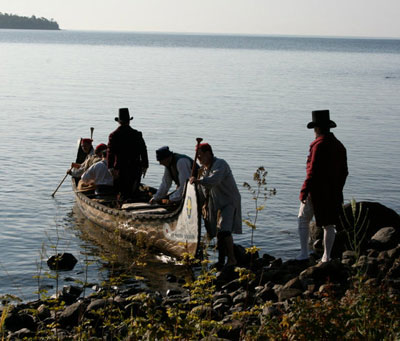
Not much to report of late since moving from one event to another over the past 8 months has meant equipment repair and preparation, not to mention also working.
Last weekend was the Fall Gathering at the Snake River fur post in Pine City which was great--good weather, better friends!
Coming at the end of September/first weekend of October is the Living History Event in Eagle River, WI. This event used to be in February (-40, as seen below). Should be be much warmer and, I hope, drier than it has been the past few days.
I'll post some pix of the trade goods I've prepared for this year's event--packages and fabric bolts. Between my goods, Karl Koster's, and Dave Klessig's I think we'll have a very full trading post.
Haven't had a chance to get out to gather oak gall due to weather and other commitments. I hope to get out next week or the first week in October.
I will be processing the oak galls at Eagle River in preparation to make more ink to dehydrate for powder (batch number 5; batch number 4 was small but very nice and for sale along with a couple of batch 3 left).
Thursday, September 23, 2010
Tuesday, September 7, 2010
Grand Portage revisited, pt 2 Punch and friends
Early one evening during Rendezvous week at Grand Portage, Mr Punch made his appearance. No modern or PC character he, this was the 18th century antagonist, the street theater Punch of Everyman.
The English street show grew out of the Commedia del Arte tradition of Italian theater. Pulchinello found new homes and audiences outside Italy, becoming the founding character for a variety of puppet traditions throughout Europe. Coming to England in the 17th century as a marionette (though he was already a glove puppet, too, in Italy), Punch as he became known soon moved from a comedy relief character in larger theater pieces at fairs, notably Bartholomew Fair, to a character with his own story, outlook, and personna.
England already had a long tradition of glove puppetry. Punch began life as a glove puppet "out front", doing fight schtick and inviting the public into see the larger marionette productions (you can see such characters in Hogarth look at right side of the photo for the glove puppets, with a painting of Punch with his wife, Joan, in a wheelbarrow).
Although there is a lot of exposition behind what is really going on behind the action of Punch (political and social, the rage of the lower/middling classes to the institutions that controlled their lives, and so on), suffice it to say that Punch represented the "great unwashed" who enjoyed the show for what it was and what Punch was able to do.
Even though the actual crowd at Grand Portage would not have seen something like this, Punch and his puppet cohorts had existed in the New World for a couple centuries, certainly being performed along the Atlantic seacoast according to various accounts (ref. Paul McPharlin's "Puppetry in America"). The audience attending this 18th century performance, albeit in the summer of this year, were definitely engaged. I was a bit apprehensive of the children in the audience, but they were even more vocal and boisterous, encouraging Punch, than their elders.
All in all, I want to thank Ft William Historical Park for "calling my bluff" and encouraging me, as a professional puppeteer in real life, to mount this show for their July rendezvous, and Grand Portage for inviting me to present, too. And most of all, the audience. I believe that puppeteers and reenactors are the two groups who present the best audiences for this type of show, understanding both the context and temper of the times, and the Art.
Next up for Punch, the North American Voyageur's Council Fall Gathering (NAVC) in November at Folle Avoine, Danbury WI.
The English street show grew out of the Commedia del Arte tradition of Italian theater. Pulchinello found new homes and audiences outside Italy, becoming the founding character for a variety of puppet traditions throughout Europe. Coming to England in the 17th century as a marionette (though he was already a glove puppet, too, in Italy), Punch as he became known soon moved from a comedy relief character in larger theater pieces at fairs, notably Bartholomew Fair, to a character with his own story, outlook, and personna.
England already had a long tradition of glove puppetry. Punch began life as a glove puppet "out front", doing fight schtick and inviting the public into see the larger marionette productions (you can see such characters in Hogarth look at right side of the photo for the glove puppets, with a painting of Punch with his wife, Joan, in a wheelbarrow).
Although there is a lot of exposition behind what is really going on behind the action of Punch (political and social, the rage of the lower/middling classes to the institutions that controlled their lives, and so on), suffice it to say that Punch represented the "great unwashed" who enjoyed the show for what it was and what Punch was able to do.
Even though the actual crowd at Grand Portage would not have seen something like this, Punch and his puppet cohorts had existed in the New World for a couple centuries, certainly being performed along the Atlantic seacoast according to various accounts (ref. Paul McPharlin's "Puppetry in America"). The audience attending this 18th century performance, albeit in the summer of this year, were definitely engaged. I was a bit apprehensive of the children in the audience, but they were even more vocal and boisterous, encouraging Punch, than their elders.
All in all, I want to thank Ft William Historical Park for "calling my bluff" and encouraging me, as a professional puppeteer in real life, to mount this show for their July rendezvous, and Grand Portage for inviting me to present, too. And most of all, the audience. I believe that puppeteers and reenactors are the two groups who present the best audiences for this type of show, understanding both the context and temper of the times, and the Art.
Next up for Punch, the North American Voyageur's Council Fall Gathering (NAVC) in November at Folle Avoine, Danbury WI.
Sunday, September 5, 2010
Grand Portage revisited, pt 1
This year's trip to Grand Portage started earlier than usual, picking up Gene Tisdal, Henri, at the Duluth airport before arriving late at night, well early in the morning, in the 18th century of Lake Superior's premier historic site and encampment. You can see a few of the sights on FrontierFolk postings such as this one (check a few others on the Colonial Nouvelle France/New France section of FF).
As usual, the week in the countinghouse talking with visitors to the site and interpreting both fur trade history and the business end of the . . . business was terrific! In addition, the Department of the Interior has been filming a movie for the interpretive center at the site since July and was using the August Rendezvous to move into high gear, filming canoe brigades on the Lake, the Native inhabitants of the Portage, and the frenzy of activity that took place during the summer while trade goods from Montreal where unloaded for distribution to the interior and furs from the interior posts were readied for the journey to Montreal.
Many photos from the week, and the shoot, have been posted on Frontier Folk and FaceBook. If you have trouble finding some of them, let me know and I'll pass along the URLs since there are just too many to post here.
A few here may whet your appetite. The partners meeting is a traditional event, with the various wintering partners reporting on the year's returns and the trade good needs for the coming year.
At the end of the Rendezvous, the partners who don't winter over leave for the safety and comfort of their hearths in Montreal, while the rest of us return to the interior and the search for our "gold", the beaver fur.
Next up, part two, Punch and his wife attend the Rendezvous at Grand Portage.
As usual, the week in the countinghouse talking with visitors to the site and interpreting both fur trade history and the business end of the . . . business was terrific! In addition, the Department of the Interior has been filming a movie for the interpretive center at the site since July and was using the August Rendezvous to move into high gear, filming canoe brigades on the Lake, the Native inhabitants of the Portage, and the frenzy of activity that took place during the summer while trade goods from Montreal where unloaded for distribution to the interior and furs from the interior posts were readied for the journey to Montreal.
Many photos from the week, and the shoot, have been posted on Frontier Folk and FaceBook. If you have trouble finding some of them, let me know and I'll pass along the URLs since there are just too many to post here.
A few here may whet your appetite. The partners meeting is a traditional event, with the various wintering partners reporting on the year's returns and the trade good needs for the coming year.
At the end of the Rendezvous, the partners who don't winter over leave for the safety and comfort of their hearths in Montreal, while the rest of us return to the interior and the search for our "gold", the beaver fur.
Next up, part two, Punch and his wife attend the Rendezvous at Grand Portage.
Saturday, September 4, 2010
Gall nuts, gall nuts, who's got the gall nuts?
This is the first in a flurry of posts; I probably should space them out but I've got the time over the long weekend so here goes:
Gall nuts are starting to appear. Apparently, the weather or something has delayed the wasp egg laying component here in the Upper Midwest. I've been finding gall nuts, though not as abundantly as I would hope. Going up to the oak savannah in Anoka MN next week to check out the supply there.
The gall nuts I have found have ranged from dried to green and probably still containing the larvae. They are, for the most part, rather large. I've picked a few green ones as an experiment to see how they compare.
Next up, Grand Portage's countinghouse and the movie filmed there, and Punch and Judy arrive at Grand Portage from the 18th century. See you in a day or so.
Gall nuts are starting to appear. Apparently, the weather or something has delayed the wasp egg laying component here in the Upper Midwest. I've been finding gall nuts, though not as abundantly as I would hope. Going up to the oak savannah in Anoka MN next week to check out the supply there.
The gall nuts I have found have ranged from dried to green and probably still containing the larvae. They are, for the most part, rather large. I've picked a few green ones as an experiment to see how they compare.
Next up, Grand Portage's countinghouse and the movie filmed there, and Punch and Judy arrive at Grand Portage from the 18th century. See you in a day or so.
Thursday, July 29, 2010
Where have all the gall nuts gone?
. . . long time passing . . .
A scrivener song by Pierre Seeger? Well, undoubtedly not, but an anthem for me this season nonetheless.
Oak gall nuts seem to be missing in action this summer, at least in the Upper Midwest area around the Twin Cities. I don't know if this is due to the weather or climate's effect on the wasps that usually lay the eggs in the oak branches creating the galls or some other cause. Missouri, on the other hand, seems to be having a bumper crop year.
Bees in general have been going missing and although I've seen a few wasps and hornets of late, nothing like former years. Local calligraphers who use the galls to make their ink, too, have been unable to find the galls around here. George Yanagita, from whom I've received a few bags harvested in the backyard marsh, hasn't seen any in his oak trees this year.
A conundrum to say the least.
As a result of my weekend of fur trade interpretation at Madeline Island demonstrating ink making and so on, I am preparing and drying a new batch of ink for powder. Maybe I can salvage something from the summer. If you have oak galls in your backyard and are close enough to make harvesting and transfer to me possible, let me know.
A scrivener song by Pierre Seeger? Well, undoubtedly not, but an anthem for me this season nonetheless.
Oak gall nuts seem to be missing in action this summer, at least in the Upper Midwest area around the Twin Cities. I don't know if this is due to the weather or climate's effect on the wasps that usually lay the eggs in the oak branches creating the galls or some other cause. Missouri, on the other hand, seems to be having a bumper crop year.
Bees in general have been going missing and although I've seen a few wasps and hornets of late, nothing like former years. Local calligraphers who use the galls to make their ink, too, have been unable to find the galls around here. George Yanagita, from whom I've received a few bags harvested in the backyard marsh, hasn't seen any in his oak trees this year.
A conundrum to say the least.
As a result of my weekend of fur trade interpretation at Madeline Island demonstrating ink making and so on, I am preparing and drying a new batch of ink for powder. Maybe I can salvage something from the summer. If you have oak galls in your backyard and are close enough to make harvesting and transfer to me possible, let me know.
Tuesday, February 23, 2010
Ink Batches
Amazingly, I have been able to post twice in one month! I need to restrain myself lest expectations rise to unattainable heights.
A new batch of ink is completed and is awaiting the completion of the slow dehydration process in the oven. Unlike batch numbered 3, this ink has a very dark, stout character with a bit of shine. Batch 2 as you will recall seemed a bit timid and not quite as permanently impressed upon the paper fiber as I would have liked, though still quite usable.
So, I should have a completely adequate supply of period correct 18th century ink ready for sale come Spring.
Packaging is set set, with instructions in both period and (inside) modern day wording.
Now, I await the return of Spring, the budding oaks, the busy wasps, and nascent galls ready to be turned into more ink . . .
A new batch of ink is completed and is awaiting the completion of the slow dehydration process in the oven. Unlike batch numbered 3, this ink has a very dark, stout character with a bit of shine. Batch 2 as you will recall seemed a bit timid and not quite as permanently impressed upon the paper fiber as I would have liked, though still quite usable.So, I should have a completely adequate supply of period correct 18th century ink ready for sale come Spring.
Packaging is set set, with instructions in both period and (inside) modern day wording.
Now, I await the return of Spring, the budding oaks, the busy wasps, and nascent galls ready to be turned into more ink . . .
Thursday, February 18, 2010
Putting electronic quill to electronic laid paper
I find myself apparently as constant a correspondent by this means as I was consistent with letter and thank-you writing in my youth. In other words, not so much. I beg your pardon for my lack, though with the steady stream of postings from others I doubt my missives have been sorely missed.
Still, the purpose of this setting seems to be to generate a persistent flow of communication about the subjects of interest to the originator. And to this task I have not stayed true. I could plead that "life intrudes" as it has with work, family, and other commitments. I could as well plead that I had nothing of note, at least to me, that seemed worthy of your ear.
This is not to say your correspondent has not been busy with attention to those things pertaining to the Clerk.
Indeed, since my last missive in November regarding NAVC's Fall Gathering, I have, amongst other endeavors, spent a good deal of time reading a pile of books and journal articles (I won't bore you with a list, you can send me a message if you want a "reading list") regarding 18th century shipping, trade, merchant activity, insurance, and other subjects relevant to 18th century economics. I hope that I can, at a not too future date, put together an article or presentation regarding the understanding I have gained in this area as regards the economic workings of the fur trade. With, I hope, a practical application, such as my workshop "And Take a Receipt", which examines the fairly dry topic of: "the type and use of fur trade documents to figure out the cost and profit on a 2 1/2 point blanket and its comparative value both to trader and Native in the context of 18th century price structure" and presents the information in concrete terms applicable to the interpreter.
That said, I've taken up mixing the latest potion of ink, using the last of my oak galls. I hope these are a better batch than the last one which did not produce a colorfast a liquid as previous concoctions. I will also be using a dried gum Arabic rather than the liquid form more readily available in art stores. I will chronicle that venture in the next "chapter" in our continuing serial. With, it is to be hoped, not such a long gap.
Still, the purpose of this setting seems to be to generate a persistent flow of communication about the subjects of interest to the originator. And to this task I have not stayed true. I could plead that "life intrudes" as it has with work, family, and other commitments. I could as well plead that I had nothing of note, at least to me, that seemed worthy of your ear.
This is not to say your correspondent has not been busy with attention to those things pertaining to the Clerk.
Indeed, since my last missive in November regarding NAVC's Fall Gathering, I have, amongst other endeavors, spent a good deal of time reading a pile of books and journal articles (I won't bore you with a list, you can send me a message if you want a "reading list") regarding 18th century shipping, trade, merchant activity, insurance, and other subjects relevant to 18th century economics. I hope that I can, at a not too future date, put together an article or presentation regarding the understanding I have gained in this area as regards the economic workings of the fur trade. With, I hope, a practical application, such as my workshop "And Take a Receipt", which examines the fairly dry topic of: "the type and use of fur trade documents to figure out the cost and profit on a 2 1/2 point blanket and its comparative value both to trader and Native in the context of 18th century price structure" and presents the information in concrete terms applicable to the interpreter.
That said, I've taken up mixing the latest potion of ink, using the last of my oak galls. I hope these are a better batch than the last one which did not produce a colorfast a liquid as previous concoctions. I will also be using a dried gum Arabic rather than the liquid form more readily available in art stores. I will chronicle that venture in the next "chapter" in our continuing serial. With, it is to be hoped, not such a long gap.
Subscribe to:
Posts (Atom)