Bouillotte
Players:
3-5
Cards:
20-24 cards; counters or chips used as bets
Use a
"Picket" deck (suited 32-card pack, lacking ranks 2–6) reduced to 20
cards by removing sevens, tens, and Jacks. If >5 people play the Jacks are
not removed; if 3 play the queens are removed as well. Ace is high.
Play
Clockwise
Determine
where a person sits: sequence cards are taken out of the deck equal to the
number of players (e.g., with 4 players, an ace, king, queen, and nine are
taken, etc.), shuffled,, and each player draws one. Player with the ace chooses
where to sit first, etc. Player with the king deals.
Before
dealing players "ante" one counter. On play round each may
"raise", those not "seeing" the "raise" being
obliged to drop out. Three cards are dealt to each player, the next being
turned face up (the retourné). Each player must then bet,
call, raise or drop out. When a call is made the hands are show and the best
hand wins. Win rank order: (the brélans)
1. Four of a kind, one
being that retourné
2. Three
of a kind, ace being high
3. Three
of a kind, one being the retourné
If more
than one player has a brélan
the best matches the turn up or retourné; if none match the turn up then highest rank wins. Any player with a brélan
gets a side payment of one chip, two if four of a kind, from each opponent.
If no one holds a
brélan all dealt cards along with the
turn up are shown and those of each suit valued (ace 11, face 10, others per
their spots). The player, not having dropped out, holding the highest card in
the suit with highest counted value and wins the pot.
Whist
Players 4
Cards 52 (Ace high)
Play
clockwise
Partnership
play; partners sitting opposite. Deck is cut or drawn to determine partners
(two highest vs. two lowest) and then to determine deal. No comment or signal
on the cards is permissible. Cards are shuffled, cut, and dealt one card at a
time face down so that each player has thirteen cards. The final card, which
belongs to the dealer, is turned up and is trumps. That card remains face up
until the dealer 's turn to play the first trick.
Play
continues until all thirteen tricks are played. Count the number of tricks each
player has scoring 1
point for each trick won in excess of 6. The game is over when a partnership
reaches 5 points. In some longer variations of whist where winning score is
higher than five, extra points (honours) are assigned after a game to a partnership
if they were dealt the ace, king, queen, and jack (knave) of the trump suit; a
partnership with three of four honours (A, K, Q, J) receive 2 points, four
points for all four. However final game winning point cannot come from honours
points.
Hazard
Players 2+
Dice 2
Only one
player, the caster, may hold and play the dice at one time. In each round the
caster specifies a number, 5 through 9, which is called the "main".
The dice are cast.
- If he rolls the main, he wins (throws in or nicks).
- If he rolls a 2 or a 3, he loses (throws out).
- If he rolls an 11 or 12, the result depends on the main:
- with a main of 5 or 9, he throws out with both an 11 and a 12;
- with a main of 6 or 8, he throws out with an 11 but nicks with a 12;
- with a main of 7, he nicks with an 11 but throws out with a 12.
- If he neither nicks nor throws out, the number thrown is called the chance. He throws the dice again:
- if he rolls the chance, he wins;
- if he rolls the main, he loses (unlike on the first throw);
- if he rolls neither, he keeps throwing until he rolls one or the other, winning with the chance and losing with the main.
The caster
continues until he loses three times in a row and thence passes the dice to his
left.
Bets are
made between the caster and the "setter" (the bank which can be an
individual or the players as a group). If the caster nicks the first throw, he
wins his stake. After the first throw the caster wins his stake if he gets his
chance before his main. After the first throw the caster and others, as side
bets, may wager that chance will come before the main.
**** Here
there are odds tables that can be used but I kind of think this will make for
really confusing reading and extra length. We could include a URL for the odds
tables. But I think messing with odds is something that would detract from
play, rather than just side betting--whose going to remember or want to
calculate? I've included the odds tables and explanation here just FYI:
These bets are made at odds determined by the relative proportions of the
main and the chance:
Main
|
Chance
|
||||||
4
|
5
|
6
|
7
|
8
|
9
|
10
|
|
5
|
4/3
|
—
|
4/5
|
2/3
|
4/5
|
1/1
|
4/3
|
6
|
5/3
|
5/4
|
—
|
5/6
|
1/1
|
5/4
|
5/3
|
7
|
2/1
|
3/2
|
6/5
|
—
|
6/5
|
3/2
|
2/1
|
8
|
5/3
|
5/4
|
1/1
|
5/6
|
—
|
5/4
|
5/3
|
9
|
4/3
|
1/1
|
4/5
|
2/3
|
4/5
|
—
|
4/3
|
Gama'giwe'binigowin (The Snake Game)
Players 2+
Equipment
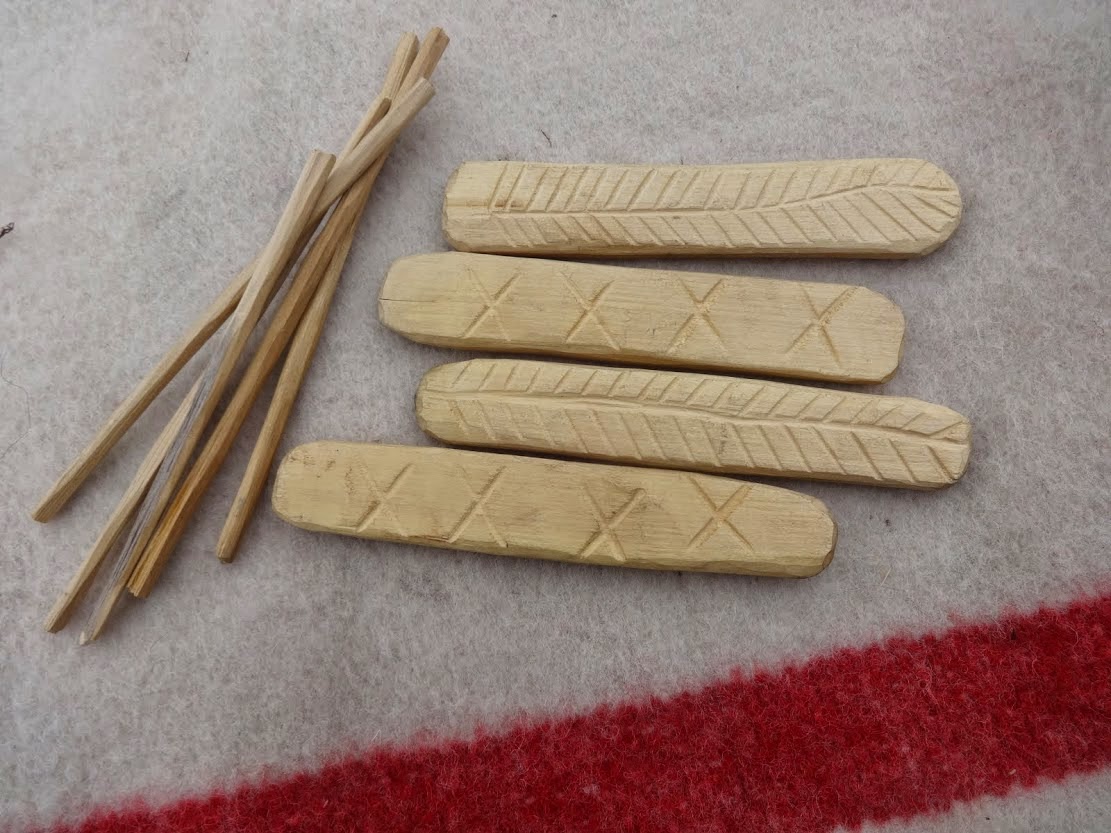 |
| crafter and photo credit: Jeremy Kingsbury |
Equipment
Four
flat sticks of even length (some players carve wavy sticks to mimic snakes), 6
or more counter sticks. The four flat sticks are marked so one side will be the
same for all four and on the opposite side of two sticks identical markings are
made (none on the other two).
The
players take turns tossing the sticks up or to the ground; points are
determined by their fall. If all sticks show same marking, take two counter
sticks and throw again until a toss produces no points. If a toss produces two
pairs of matching sticks, take one counter and throw again. No other counts are
allowed. During play a player may also take counter sticks from other players
if the common or bank pile is empty. When a player has gained all counter
sticks that player wins.
Bets are
made before each toss with the player tossing making the first bet. Side bets
between players and onlookers can also be made (will the toss be successful?
what will be tossed? and so on). The side bets can often be the most
entertaining and profitable.